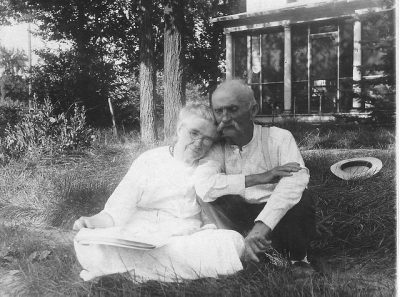
A story of an aging couple…as told by their son

This is a wonderful piece by Michael Gartner, editor of newspapers large and small and president of NBC News. In 1997 he won the Pulitzer Prize for editorial writing. It is well worth reading. A few good chuckles are guaranteed.My father never drove a car. Well, that’s not quite right. I should say I never saw him drive a car.
He quit driving in 1927, when he was 25 years old, and the last car he drove was a 1926 Whippet.
“In those days,” he told me when he was in his 90s, “to drive a car you had to do things with your hands, and do things with your feet, and look every which way, and I decided you could walk through life and enjoy it or drive through life and miss it.”At which point my mother, a sometimes salty Irishwoman, chimed in:
“Oh, baloney!” she said. “He hit a horse.”

“Well,” my father said, “there was that, too.”

So my brother and I grew up in a household without a car. The neighbors all had cars — the Kollingses next door had a green 1941 Dodge, the VanLaninghams across the street a gray 1936 Plymouth, the Hopsons two doors down a black 1941 Ford — but we had none.

My father, a newspaperman in Des Moines , would take the streetcar to work and, often as not, walk the 3 miles home . If he took the streetcar home , my mother and brother and I would walk the three blocks to the streetcar stop, meet him and walk home together.

My brother, David, was born in 1935, and I was born in 1938, and sometimes, at dinner, we’d ask how come all the neighbors had cars but we had none. “No one in the family drives,” my mother would explain, and that was that.

But, sometimes, my father would say, “But as soon as one of you boys turns 16, we’ll get one.” It was as if he wasn’t sure which one of us would turn 16 first.

But, sure enough , my brother turned 16 before I did, so in 1951 my parents bought a used 1950 Chevrolet from a friend who ran the parts department at a Chevy dealership downtown.

It was a four-door, white model, stick shift, fender skirts, loaded with everything, and, since my parents didn’t drive, it more or less became my brother’s car.

Having a car but not being able to drive didn’t bother my father, but it didn’t make sense to my mother..

So in 1952, when she was 43 years old, she asked a friend to teach her to drive. She learned in a nearby cemetery, the place where I learned to drive the following year and where, a generation later, I took my two sons to practice driving. The cemetery probably was my father’s idea. “Who can your mother hurt in the cemetery?” I remember him saying more than once.

For the next 45 years or so, until she was 90, my mother was the driver in the family. Neither she nor my father had any sense of direction, but he loaded up on maps — though they seldom left the city limits — and appointed himself navigator. It seemed to work.

Still, they both continued to walk a lot. My mother was a devout Catholic, and my father an equally devout agnostic, an arrangement that didn’t seem to bother either of them through their 75 years of marriage.

(Yes, 75 years, and they were deeply in love the entire time.)

He retired when he was 70, and nearly every morning for the next 20 years or so, he would walk with her the mile to St. Augustin’s Church.
She would walk down and sit in the front pew, and he would wait in the back until he saw which of the parish’s two priests was on duty that morning. If it was the pastor, my father then would go out and take a 2-mile walk, meeting my mother at the end of the service and walking her home .

If it was the assistant pastor, he’d take just a 1-mile walk and then head back to the church. He called the priests “Father Fast” and “Father Slow.”

After he retired, my father almost always accompanied my mother whenever she drove anywhere, even if he had no reason to go along. If she were going to the beauty parlor, he’d sit in the car and read, or go take a stroll or, if it was summer, have her keep the engine running so he could listen to the Cubs game on the radio. In the evening, then, when I’d stop by, he’d explain: “The Cubs lost again. The millionaire on second base made a bad throw to the millionaire on first base, so the multimillionaire on third base scored.”

If she were going to the grocery store, he would go along to carry the bags out — and to make sure she loaded up on ice cream. As I said, he was always the navigator, and once, when he was 95 and she was 88 and still driving, he said to me, “Do you want to know the secret of a long life?”

“I guess so,” I said, knowing it probably would be something bizarre.

“No left turns,” he said.

“What?” I asked.

“No left turns,” he repeated. “Several years ago, your mother and I read an article that said most accidents that old people are in happen when they turn left in front of oncoming traffic.

As you get older, your eyesight worsens, and you can lose your depth perception, it said. So your mother and I decided never again to make a left turn.”

“What?” I said again.

“No left turns,” he said. “Think about it.. Three rights are the same as a left, and that’s a lot safer. So we always make three rights..”

“You’re kidding!” I said, and I turned to my mother for support.
“No,” she said, “your father is right. We make three rights. It works.”
But then she added: “Except when your father loses count.”

I was driving at the time, and I almost drove off the road as I started laughing.

“Loses count?” I asked.

“Yes,” my father admitted, “that sometimes happens. But it’s not a problem. You just make seven rights, and you’re okay again.”

I couldn’t resist. “Do you ever go for 11?” I asked.

“No,” he said ” If we miss it at seven, we just come home and call it a bad day. Besides, nothing in life is so important it can’t be put off another day or another week.”
My mother was never in an accident, but one evening she handed me her car keys and said she had decided to quit driving. That was in 1999, when she was 90.

She lived four more years, until 2003. My father died the next year, at 102.

They both died in the bungalow they had moved into in 1937 and bought a few years later for $3,000. (Sixty years later, my brother and I paid $8,000 to have a shower put in the tiny bathroom — the house had never had one. My father would have died then and there if he knew the shower cost nearly three times what he paid for the house.)

He continued to walk daily — he had me get him a treadmill when he was 101 because he was afraid he’d fall on the icy sidewalks but wanted to keep exercising — and he was of sound mind and sound body until the moment he died.

One September afternoon in 2004, he and my son went with me when I had to give a talk in a neighboring town, and it was clear to all three of us that he was wearing out, though we had the usual wide-ranging conversation about politics and newspapers and things in the news.

A few weeks earlier, he had told my son, “You know, Mike, the first hundred years are a lot easier than the second hundred.” At one point in our drive that Saturday, he said, “You know, I’m probably not going to live much longer.”

“You’re probably right,” I said.

“Why would you say that?” He countered, somewhat irritated.

“Because you’re 102 years old,” I said.

“Yes,” he said, “you’re right.” He stayed in bed all the next day.

That night, I suggested to my son and daughter that we sit up with him through the night.

He appreciated it, he said, though at one point, apparently seeing us look gloomy, he said:
“I would like to make an announcement. No one in this room is dead yet”

An hour or so later, he spoke his last words:

“I want you to know,” he said, clearly and lucidly, “that I am in no pain. I am very comfortable. And I have had as happy a life as anyone on this earth could ever have.”

A short time later, he died.

I miss him a lot, and I think about him a lot. I’ve wondered now and then how it was that my family and I were so lucky that he lived so long.

I can’t figure out if it was because he walked through life,
Or because he quit taking left turns. “

Life is too short to wake up with regrets.

So love the people who treat you right.

Forget about the ones who don’t.

Believe everything happens for a reason.

If you get a chance, take it & if it changes your life, let it.

Nobody said life would be easy, they just promised it would most likely be worth it.”
ENJOY LIFE NOW – IT HAS AN EXPIRATION DATE!
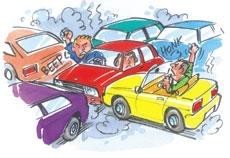

Traffic

So…you think that we have traffic congestion NOW?…just wait as our population continues to grow.

Infrastructure is one of the primary responsibilities of a city. In addition to police/fire protection, and other essentials that are necessary.

Streets are essential in order to safely move people from one point to another. The lack of primary streets is a problem today and needs to be corrected…before it becomes an inexcusable hazard. Safety and convenience should be a priority…for all existing citizens.

At this time, we have the “Cart in Front of the Horse”

Is there a solution?

Responsible decisions of spending taxpayers money need to be made in the best interest of its citizens that live here…approving multi-family developments and spending money to entice people to move here which will only magnify the problem.

The City Council has allocated money to infrastructure but it is not adequate. We spend more money partnering with the private sector or competing with them than we do with the essentials that need to be addressed.

“Growth is inevitable…but Responsible Growth is a Necessity”   

Where do you live?

This question doesn’t pertain to a geographical area…but one of your mind-set and reality.

Even though our body lives in the present, our thoughts and decisions do not always follow it’s lead.

In my opinion there is no right or wrong answer to this question… and its above my pay grade to judge, but I do find it interesting to analyze myself as well as others based on their actions.

If you should decide to do the same consider the three components of past, present and future.  Start with a 100% and start moving the scale based on your mind-set and the decisions that you make in your daily life….and analyze the results.  If the end result doesn’t  provide a form of contentment  within yourself …just remember only you have the ability to change it.

I know many people who live the majority of their time in the past.  When you are around them they are always reflecting on the past and most of their conversation always starts with… I remember when…They retain the same small circle of friends that they have brought with them to the present to relive those past moments  ever time they get together.  Current events or future plans are very seldom discussed…unless it’s a conversation about when they plan to get together again.

I am a person who lives the majority of his time in the present.  There are many poetic clichés that I could use to reference this…but I won’t.  For me…the past is the past…I can’t change it…its over.  I do have what I refer to as 15 second flashbacks …some are painful…some are happy moments but the more time you spend there the more you steal from the present. The future for me is about 2 weeks from the present.  Is this a healthy environment to live in?…probably not if you ask an economist or financial planner.  I have become comfortable and content with my life… by doing what is necessary in the present… to produce the financial means for that comfort.

The people that live for the future are some of the most optimistic people that I know. They are certain that there is a future and are constantly preparing for it. These individuals tend to lose site of “living life in the present” by only preparing for the future…and when (and if) their definition of the future arrives unfortunately their health and physical condition may prevent them from enjoying the fruits of their labor. The only thing that I am certain about is that the past is gone… the future is not guaranteed and at the time I wrote this…there was a present.

So…back to the original question…where do you live?

Fact vs Opinion

FACT: …that which can be proven. Not hypothetical or ones opinion.
OPINION: …one’s view of a subject matter that is a belief…but cannot be supported with facts. A philosophical difference, as one may view a particular subject.
An Opinion that is supported by Facts….TRUTH.
We live in America where everyone has the right to have their own opinion…but not their own facts.
Politicians and political pundits have a language of their own where facts are not important…but “8 second sound bites” are. Their intent is that the 8 seconds will resonate with the “listener” without challenging the statement…and then later repeat it as fact.
There is always something under the surface, other than dirt…if you dig deep enough to investigate or challenge the 8-second sound bite.
Knowledge is powerful…when properly applied.

Lessons of Life…

Regina Brett, 90 years in age of

The Plain Dealer in Cleveland, Ohio…Listed 45 lessons that life has taught him.

Below are 15 of my favorite…

  1. Life isn’t fair, but it’s still good.
  2.  Life is too short to waste time hating anyone.
  3. Your job won’t take care of you when you are sick. Your friends and parents will. Stay in touch.
  4. You don’t have to win every argument. Agree to disagree.
  5. Cry with someone. It’s more healing than crying alone.
  6. Make peace with your past so it won’t screw up the present.
  7.  Don’t compare your life to others. You have no idea what their journey is all about.
  8.  It’s never too late to have a happy childhood. But the second one is up to you and no one else.
  9. Burn the candles, use the nice sheets, and wear the fancy lingerie. Don’t save it for a special occasion. Today is special.
  10. Be eccentric now. Don’t wait for old age to wear purple.
  11. No one is in charge of your happiness but you.
  12. Don’t take yourself so seriously. No one else does.
  13. Don’t audit life. Show up and make the most of it now.
  14. All that truly matters in the end is that you loved.
  15. Envy is a waste of time. You already have all you need.

Realism Idealism

Realistic :

  • Mansfield, Texas approx. 80,000 people
  • Average household income is approx. $126,000.00 per year.
  • Approx. 92% of the working population travel elsewhere to work.
  • They moved here (and travel to their work) because they chose to live in a suburban neighborhood with good schools to raise a family  away from the high-density, traffic and crime of Ft. Worth / Dallas.
  • Those people and the residents before us have established who we are today and paid the price to be…”Minutes from Everything and Second to None.”

Idealistic :

  • To increase population to 150,000 on 25% of the land that hasn’t been developed and add other amenities to accommodate that growth without destroying what has made us unique. Not possible.
  • To bring the majority of those individuals back to work here…that chose to be away from their work? Unrealistic.  
  • To have world-class amenities (not sure exactly what that means).
  • To be “everything to everyone.” Not possible

Growth is inevitable…but the right leadership should focus on making decisions to support what has made us desirable. The wrong growth will eventually drive the current population elsewhere…history will repeat itself if we don’t learn from it.  

Reduced to the Ridiculous…for interpretation

“A strategy used by breaking down what has been said or shown into a more simplified understandable illustration…if possible.”

In short …a method of taking “rambling misunderstandable rhetoric” and evaluating it to an understandable explanation…if there is one.

Example:

If you go the top of a mountain which is 36,000 feet and stand on the edge of a cliff and calculate that it would take 38 seconds to reach the bottom  traveling at 97 miles per hour if you should decide to jump…what would be the end result at impact?

Reduced to the Ridiculous…If you jump off a 36,000 ft. cliff…you will be dead when you hit the bottom…the end result.

Rambling misunderstandable rhetoric is usually for the benefit of the person making the presentation…to show superiority, misrepresent, or to confuse one not to challenge the content.

Never be afraid to challenge “rambling misunderstandable rhetoric”.

“It Just Wasn’t My Time”… 2018

A few months ago I experienced an unexpected episode…Cardiac Arrest.

People often use the terms heart attack and cardiac arrest as interchangeable, but they are not synonyms.  In cardiac arrest the heart rhythm causes the heart to stop beating.  Without quick treatment, it causes sudden cardiac death. The national average survival rate is a little over 10% and survival with good neurological function is little more than 8%.

I wasn’t familiar with the information above until after my episode…”I am one lucky guy”.

I can honestly say that my wife loves me…otherwise you wouldn’t be reading this.  In the middle of the night she noticed that I was moaning but not breathing…she immediately dialed  911, and with the instructions on the other end of the phone she begin to perform CPR until the first responders arrived. With their training and equipment they took over and after a few minutes I was rushed to the hospital… where my wife was told of the statistics that I listed above.  If the roles were reversed I am not sure that I would have been able to deal with those words and expectations…she truly is the better half.

I was told that a series of techniques was used by the doctors and their staff to stabilize me and prepare me for surgery…at which time I received three stents in my heart.  My wife was told that the next 24 hours would be critical…and not to expect the best…if I survived.

I was in the hospital for four days…but it wasn’t until 3 days after leaving the hospital that I was made aware of what had occurred….even though I remember nothing during that 7-day period.   My wife informed me that after surgery (and regaining consciousness after the critical wait period) that I had normal conversations with friends and the hospital staff…well “almost” normal conversations…once again I had beaten the odds in regard to the neurological functions.  My “buddies” tend to disagree with that assessment.  My response to them…I went in “brilliant” and came out “normal” just like you guys.  That really is “guy humor”.

Seven days after the cardiac arrest my wife and I visited the team of first responders, doctor and the hospital staff to thank them for their help and involvement. I special thanks to the friends that reached out to my wife and gave support and encouragement…to all we are eternally grateful.

Life is a gift with an expiration date, but apparently… it just wasn’t my time.

Johnny J

Side Note:  Goggle the American Heart Association and learn more about the cause, prevention, and how to respond to someone experiencing cardiac arrest…learn CPR.